Target Precision
Pursue the deals worth winning and screen the rest out early, before they eat the team’s capacity.
- Market & Customer Focus
- Qualification & Deal Discipline
Win rate up, wasted pursuit down
Connected Commercial Diagnostics
Five connected diagnostics read how strategy, management, seller behaviour, deal execution and measurement actually work together. Start wide, then investigate the area that matters.
Every answer is scored, banded, and turned into a specific next move. The Commercial Effectiveness Diagnostic is the front door.
5
connected diagnostics, one commercial picture
125+
calibrated questions, individually weighted
16
dimensions, rolled up to 5 business outcomes
5
maturity bands, Emerging to Leading
10
published methods behind the scoring
What it covers
Nothing floats. Every dimension we measure feeds exactly one business outcome, so a soft score always points at something a leader is trying to move: a higher win rate, protected margin, deals that stop stalling.
Pursue the deals worth winning and screen the rest out early, before they eat the team’s capacity.
Win rate up, wasted pursuit down
The case holds up to Finance and beats the rival story already in the account, without reaching for discount.
Protect margin and pricing power
Blockers get named early and accelerators get used, so deals keep moving instead of quietly stalling.
Shorter cycles, truer forecast
Every seat on the buying committee hears a version that lands for them, and the story survives the rooms you are not in.
Win the complex, multi-stakeholder deals
Ramp, honest pipeline, craft and tooling are built into how the team works, not carried by a few heroics each quarter.
Scale without watching every deal
Single-feed by design: no dimension is counted twice, so the roll-up to an outcome is honest arithmetic, not a weighting trick.
The battery
One assessment is the front door. The other four go deep on a specific question once the wide view shows where the constraint sits.
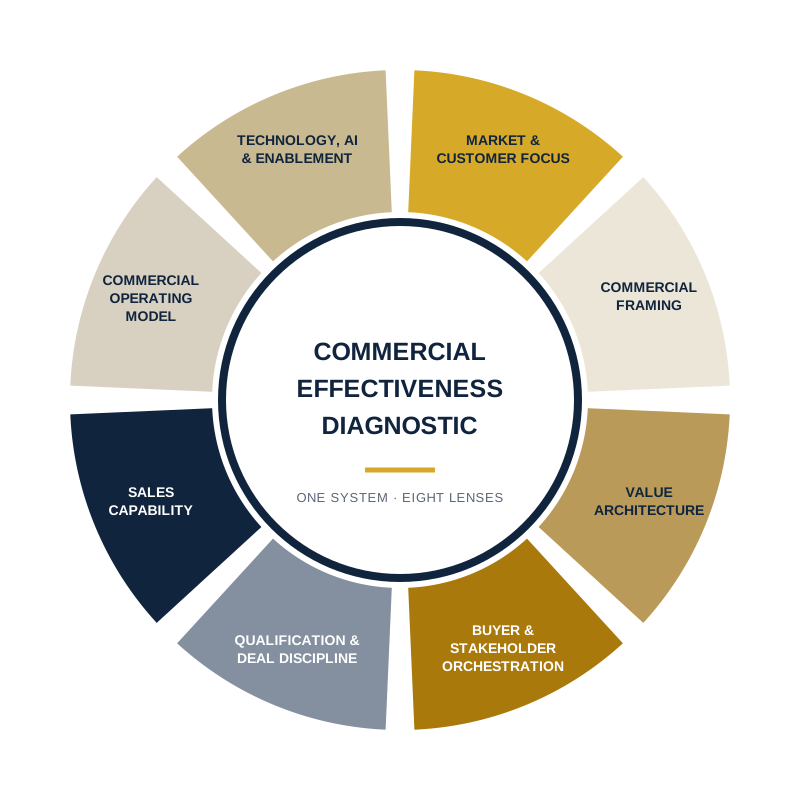
The organisation-level front door. How strategy, management, seller behaviour, deal execution and measurement connect in practice.
The craft of the selling itself, with a built-in anti-gaming check on qualification discipline that a straight self-rating cannot fake.
A single live opportunity read against the eight elements of the Value Alignment Model, from strategic objective through to decision narrative.
How the leadership layer sets direction, coaches craft and holds pipeline honesty, across the same dimensions their teams are measured on.
One seller’s shape across the full competency set, feeding both their own development report and the team’s cohort view.
Every score at every level is read against the same five bands, so a band means the same thing whether you are looking at one seller or the whole company.
See it for real
Worked examples using sample figures, not a live client. Same illustrative data, read three ways: for the individual, for the team leader, for the board.
Tier 1 · Individual
Qualification & Deal Discipline · Developing
Situation
In the first two or three conversations of a new opportunity, and in the pipeline review where walking away feels like losing.
Behaviour
Deals advance a stage on stated interest rather than confirmed budget and a defined project.
Impact
Unqualified deals quietly consume the depth of work every other opportunity needs; the no-decision months later gets filed as bad timing.
Where to next
Before your next 3 opportunities advance, write which of the 4 qualification checks you can confirm with evidence, not assumption. Re-read in 8 to 12 weeks.
No raw score shown to the individual, by design
Written in feedback order: purpose, then current state, then next step. The number never opens the report.
Tier 2 · Cohort
What the split means
A team-wide low score calls for a workshop. A wide spread calls for coaching the lower group. Two different actions, reported separately.
Suppressed below 5 respondents so no slice can be traced back to one person.
Tier 3 · Portfolio
Target Precision
Win rate up, waste down
Value Protection
Protect margin
Deal Momentum
Shorter cycles
Influence Reach
Win the complex
Commercial Engine
Scale without heroics
The one constraint
Target Precision is the floor, and Qualification Discipline is why. The board conversation is a capacity problem, not a hiring one.
Rolled up from every diagnostic into the five outcomes, no double-counting.
Privacy is a feature, not a footnote. A person taking the assessment never sees their own number, and no report ever shows a rank or a leaderboard. It kills the incentive to game the answers, which is why the data you get back is worth trusting.
Why you can trust the number
Getting an honest signal out of a person is a different problem from turning it into a score you can compare across a team, which is different again from deciding what is safe to show without the number doing damage, then turning it into action, then proving it worked. Each stage exists because the one before it is not enough on its own.
From score to action
Every dimension carries a fixed, book-grounded intervention keyed to the score. A gap does not produce a shrug. It produces a workshop or a coaching drill, with the effort, the content and the signal that tells you it worked. Here is the one behind the constraint above.
Measures how rigorously opportunities are tested for a defined project, allocated budget, genuine need and account fit, before real effort goes in.
Signal it worked: fewer deals sitting at the same stage for 2+ review cycles with no new evidence. Re-read this dimension in 8 to 12 weeks.
Signal it worked: the lower group’s stalled-deal rate closes toward the top group’s. Re-read in 8 to 12 weeks.
The whole loop
01
Each person answers a calibrated set on a 1 to 5 anchored scale. One link, resumable, about 15 minutes.
02
Answers are weighted per question, rolled up per dimension and banded, server-side. No hand marking.
03
Three reports render from the same data: individual, cohort, portfolio. Each reader sees what is safe for them.
04
Each gap pulls its fixed intervention, workshop or coaching, with effort and a re-measure signal attached.
05
Run the battery again in a quarter. The before/after delta is where a real behaviour claim comes from.
Start with the wide organisation-level view, or walk through a live sample report with us first. Either way you will leave the conversation knowing what to look at next.