







Insights

What we're seeing in complex B2B sales

Notes from real deals and real sales teams, plus the longer-form library behind the method.

Latest

Notes from the field. Read each piece in full on the page, or open the featured whitepaper for the longer research.

No Decision - The Silent Killer of Sales, a TEAMSolutions sales insight
Insights

No Decision - The Silent Killer of Sales

Around 60% of qualified opportunities die with no decision, not to a competitor. The real fight is against inaction, and it can be designed against.

Read the full piece
How Many People Are You Really Selling To, and What's Their Why?, a TEAMSolutions sales insight
Insights

How Many People Are You Really Selling To, and What's Their Why?

The reason behind a decision matters as much in sales as it does in leadership.

Read the full piece
KPIs Don't Close Deals, Execution Does, a TEAMSolutions sales insight
Insights

KPIs Don't Close Deals, Execution Does

The tension between prospecting and closing, and the leadership challenge of overloading account executives.

Read the full piece
Timeless Laws of Sales and Strategy, a TEAMSolutions sales insight
Insights

Timeless Laws of Sales and Strategy

How historical leaders and strategists shaped the thinking modern sales teams still run on.

Read the full piece
Be Agile, a TEAMSolutions sales insight
Insights

Be Agile

Agility in response and mindset keeps sales teams aligned with evolving customer priorities in shifting markets.

Read the full piece
Be Authentic, a TEAMSolutions sales insight
Insights

Be Authentic

Authenticity as a strategic advantage: genuine conversations build trust faster than process alone.

Read the full piece
Be Curious, a TEAMSolutions sales insight
Insights

Be Curious

Strategic questioning uncovers business pain, builds credibility, and generates measurable value in customer conversations.

Read the full piece
From the Army to Sales Enablement, a TEAMSolutions sales insight
Insights

From the Army to Sales Enablement

Military lessons in leadership, purpose and alignment, and how trust and shared mission build high-performing sales teams.

Read the full piece
The Third Crisis of IT, a TEAMSolutions whitepaper
Whitepaper

The Third Crisis of IT

Sales performance is collapsing from buyer complexity amplified by AI and shifting decision systems, revealing patterns that will define the next decade.

Read the whitepaperopen_in_new

No Decision - The Silent Killer of Sales

I have lost count of how many deals I thought were on track, only to watch them stall out. No competitor. No budget cut. Just… nothing.

I am not alone. Research shows that around 60% of qualified opportunities end with no decision. The solution may be sound, but the buyer still chooses not to change. Psychologists such as Daniel Kahneman describe this as status quo bias. Sales researchers Matthew Dixon and Ted McKenna argue that the real competitor is not another vendor. It is inaction.

The lesson: execution excellence is about giving buyers the confidence to move.

  • Show them the cost of doing nothing
  • Make change safer than the status quo
  • Equip your champion with language they can carry into the room

Most deals don’t die from lack of fit. They die from lack of momentum.

Why “no decision” is the biggest competitor you face

Inaction is easier than action, even when action is better. Humans are wired to avoid loss. Changing a system, a process, or a vendor feels risky, even when staying still is worse. This is why value alone doesn’t close deals. Buyers need safety. When the perceived risk of change is higher than the perceived risk of staying the same, the deal dies quietly.

Status quo bias is emotional rather than purely logical. Buyers hesitate because they fear disruption, internal scrutiny, political fallout, personal risk, hidden complexity and the unknown. The seller’s job is not simply to out-sell a competitor. It is to reduce uncertainty.

Champions need language they can use internally. Enthusiasm alone will not carry a deal. A champion must be able to explain the business pain, quantify the cost of inaction, tell the value story in their own voice, navigate internal resistance and give leadership the confidence to approve change. Without that language, the deal can stall even when the champion supports the solution.

Momentum requires deliberate work. Buyer interest alone does not create momentum. The seller needs to sequence conversations, involve the right stakeholders early, anchor each meeting to a tangible next step, show progress across the buying group and make the cost of doing nothing visible. A pipeline stage is not evidence of movement.

Many deals are not lost to competitors. They are lost to silence, hesitation and fear. The seller needs to replace those conditions with clarity, confidence and momentum. That is the gap Symphony is built to close.

How Many People Are You Really Selling To, and What's Their Why?

People do not buy only what you do. They also respond to why you do it. That applies as much to selling as it does to leadership. Too many sales teams focus on pipeline metrics and KPIs: the number of meetings, calls and demos.

But none of those tell you whether a buyer has a compelling reason to change. Between 40% and 60% of qualified opportunities end with no decision.

Not because of competition. Not because of pricing. But because the buying group never formed a strong enough why.

And in complex deals, it’s never just one why.

  • The CFO’s why is protecting budget.
  • The COO’s why is reducing operational risk.
  • The IT sponsor’s why is de-risking integration.
  • The champion’s why is credibility and career impact.

If you only sell to one of those, you’ve left the door wide open for inertia.

Execution excellence means identifying every influencer, champion, sponsor, challenger and blocker. It means speaking to each person’s reason for acting in language that matters to them, then creating a value story that brings those perspectives together. The demonstration becomes validation rather than persuasion.

When sellers start with the different reasons people may act and organise their work around them, the pipeline does more than look full. It converts.

Why one value story isn’t enough in modern B2B selling

Every stakeholder has a different future they are trying to protect. A buying group contains competing personal and departmental priorities. If your message does not recognise that, finance may default to “later”, security to “no”, IT to “not now” and operations to “show me proof”. A strong solution can still fail when it addresses only one person’s problem.

Alignment needs deliberate work. Most buying groups do not arrive aligned. They bring conflicting priorities, different definitions of value, uneven perceptions of risk, political tensions and unspoken objections. The seller needs to help the group work through those differences.

Execution excellence means sequencing conversations, not dumping information. A poor seller delivers one pitch to everyone. A strong seller gives each stakeholder the right message at the right time and builds internal momentum. The order matters. Start where the problem is felt deeply, often with a champion or operator. Demonstrate feasibility and safety with IT or security. Prove the business case with finance, then connect it to the strategic outcomes that matter to executives. This is orchestration, not pitching.

A buying group is a political system, not a linear path. Every major deal has sponsors, detractors, blockers, passive bystanders, loud supporters and quiet resistors. If you do not map the people behind the job titles, you are selling blind. Your job is to understand who matters, why they matter and what they need before they can move.

The deal doesn’t progress until everyone’s why is resolved. Most sellers mistake activity for movement. Meetings happen. Demos happen. Follow-ups happen. But movement only occurs when a stakeholder’s why is resolved enough to vote for change. If even one critical member still has an unresolved why, the safest option for the group is to do nothing.

Complex sales do not collapse only because of competitors. They also collapse when an important stakeholder’s reason for acting is not heard, addressed or valued.

Your advantage isn’t a better product. It’s better alignment.

KPIs Don't Close Deals, Execution Does

I read a post recently about the tension between prospecting and closing, and the leadership trap of piling more AEs into the top of the funnel until everyone is running both a sprint and a marathon at the same time.

The result? Full pipelines, but thin opportunities.

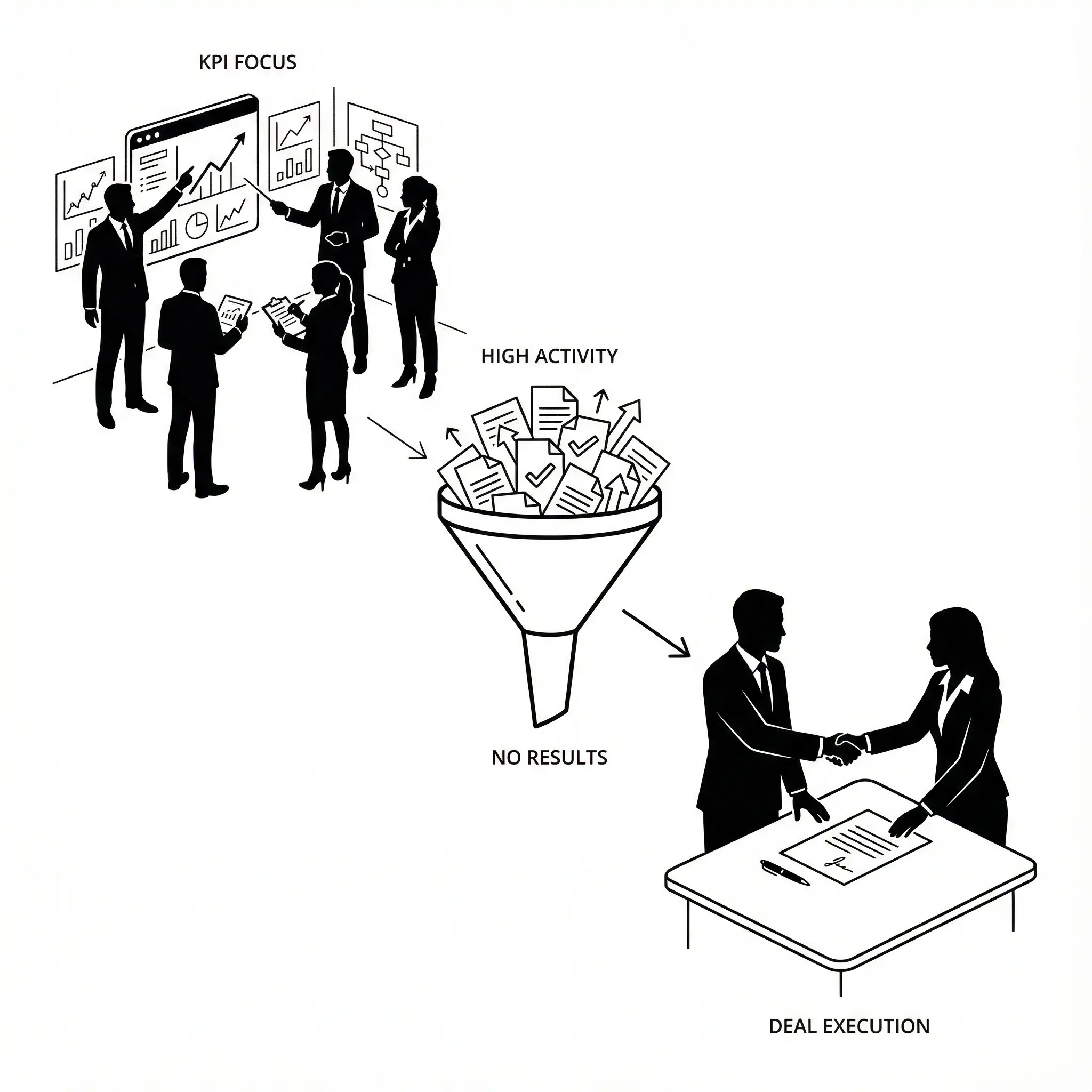
I take the argument a step further. KPIs do not do the selling for us. They measure activity rather than impact. You can hit call volumes, meetings booked and pipeline coverage ratios while still losing 60% of qualified opportunities to no decision. Competition and price are not always the reason. Inertia, bias and a lack of urgency also stop deals. That is an execution problem rather than a pipeline problem.

The difference between deals that close and deals that are “almost there” isn’t the KPI. It’s whether the seller delivered a compelling, powerfully messaged value story that mobilised the right people to act.

So the real question: are you managing KPIs, or are you managing execution? Because only one of those creates revenue.

Why execution beats activity every time

Volume creates noise. Execution creates movement. Most KPIs track whether sellers are busy. Very few KPIs track whether sellers are effective. It’s possible to work hard, stay active, generate meetings, build a pipeline, and still have nothing convert. Execution is the ability to turn activity into advancement.

Executive buyers do not care about your activity metrics. They do not care about your call count, meeting volume or cadence steps. They care about reducing risk, gaining strategic clarity, building confidence in progress, bringing their team together and producing measurable outcomes. Execution connects what you do to what they value.

Most pipelines are not fake. They are unsupported. Many deals stall because the execution around them is weak: no alignment on the buyer’s different reasons to act, no momentum plan, no clear path from today to tomorrow and no champion equipped for the internal conversations. Execution provides the structure behind the opportunity.

High-performing sellers treat KPIs as diagnostics, not goals. The best sellers don’t chase KPIs. They use KPIs. They ask why something isn’t advancing, where the friction is, who is missing from the conversation, what risk the buyer is trying to avoid, and how to reframe the message to mobilise action. Execution is about diagnosing, adjusting, and driving deals forward with intention.

A good pipeline is healthy, not merely full. A pipeline should show buyer intent, alignment across the stakeholder group, agreed next steps, a defined path to value and genuine momentum. Execution is what turns activity into progress.

You can’t manage revenue through activity alone. Execution is what turns motion into outcomes and pipelines into performance.

Timeless Laws of Sales and Strategy

As a student of history, I often wonder how some of the brightest modern minds, like Steve Jobs, might have been influenced by the great leaders and strategists of the past.

Jobs taught us to start with pain, kill complexity, and control the stage. But these ideas aren’t new. They echo lessons from centuries ago.

Sun Tzu (The Art of War). “Victorious warriors first win and then go to war.” Jobs’ mantra of preparation and simplicity mirrors Sun Tzu’s belief in shaping conditions before the first move is made. Winning in sales, like in battle, is about preparing so the outcome becomes inevitable.

Alexander the Great. “I am not afraid of an army of lions led by a sheep; I am afraid of an army of sheep led by a lion.” Jobs controlled the stage and inspired loyalty through vision. Like Alexander, he proved that leadership and conviction turn followers into influencers. Champions inside an organisation rally when the message is clear.

Horatio Nelson. “Time is everything; five minutes makes the difference between victory and defeat.” Jobs created urgency with timing, driving decisions through product launches and compelling calls to action. Nelson’s decisive use of timing at Trafalgar carries the same truth today: progress wins where hesitation fails.

Different centuries, same laws:

  • Simplify until the path is clear
  • Lead with vision and conviction
  • Prepare so the outcome is already decided
  • Act with urgency and timing

Execution excellence, whether in sales or in battle, is timeless.

Why these timeless laws still win in modern sales

Simplicity creates certainty. Customers don’t buy complexity. They buy clarity, the shortest, cleanest, most frictionless path to a better future. Leaders like Jobs and Sun Tzu understood: if you confuse, you lose; if you simplify, you speed up conviction.

Vision drives action. People rally behind a compelling “why,” not a technical feature list. Alexander built empires with belief and direction. Great sellers build influence the same way, with clear vision, clear value, and a clear destination. Vision turns a demo into a story. Stories move people.

Preparation makes success look effortless. Sun Tzu’s first rule was to shape the conditions. Jobs rehearsed product launches obsessively. Nelson planned manoeuvres before battle. In sales, preparation sharpens the narrative, strengthens the value story, supports stakeholder alignment and removes surprises before the customer sees them. Prepared sellers can respond deliberately instead of reacting blindly.

Urgency wins more deals than persuasion. Most deals don’t die from competition. They die from no decision. Nelson understood timing as a competitive advantage. Jobs mastered the art of creating decisive moments. In modern sales, urgency creates clarity, clarity creates confidence, and confidence creates movement. Deals move not when buyers understand the solution, but when they understand why waiting is the real risk.

Execution excellence beats strategy alone. Strategy without execution is theatre. Execution without strategy is chaos. Great leaders bridge the two. Execution excellence in sales means telling the right story, at the right time, to the right stakeholders, with the right level of conviction. That’s what turns potential into pipeline, and pipeline into outcomes.

Tools and technologies change. Clarity, preparation, vision and decisive action still matter.

Be Agile

Years ago, I worked with a large government organisation that had built their own call system to handle 800 to 1000 repair requests every day.

Mid-demo, they asked us to register a repair. About halfway through the workflow, the intern told us it was “for a lens under warranty.” Suddenly, it kicked to six minutes and multiple screens of data entry to complete.

They stopped me and said: “This won’t work. Our operators handle these calls in under 45 seconds.”

At that moment, the deal was dead in the water, unless we adapted.

Instead of pushing through the script, we pulled up chairs with their ops team, mapped their real 45-second process step by step, and showed how our solution could be reconfigured to match warranty checks, countermeasures, duplicate field removal, and exception-handling simplicity.

By the end of the session, they were back on board and invested in the result. They saw how the system could fit their needs rather than ours. That agility saved the deal and built long-term trust during the rollout.

We aimed for 45 seconds and reached about one minute. We also found that the new system could safely change and report information that had been locked down in the older systems. During the first week after launch, users entered more than 3,500 jobs without making a single support call. A good solution can become better when customers are given room to improve it.

Be agile. Be flexible.

  • Be present enough to listen when things go sideways.
  • Be creative enough to adjust in real time.
  • Be confident enough to show the customer you’re invested in their best outcome.

In sales, agility isn’t about throwing out preparation. It’s about doing the hard work upfront and being ready to pivot when the customer shows you a better way forward.

Rigid scripts do not close the best deals. Sellers need to think on their feet while keeping the customer’s interests in view.

What agility really creates

Agility isn’t about speed. It’s about adaptability in service of value.

True sales agility:

  • reveals hidden constraints that customers didn’t articulate
  • shows respect for how people actually work, not how we wish they worked
  • turns resistance into co-design, and co-design into ownership
  • creates credibility because you’re solving their problem, not selling your product
  • reduces friction by meeting customers at their workflow, not forcing them into yours
  • turns demos from presentations into working sessions
  • builds the emotional safety customers need to challenge you with the truth

Rigid sellers get polite smiles. Agile sellers get invited behind the curtain.

And once you’re behind the curtain, you’re no longer pitching, you’re partnering.

In modern sales, agility lets the customer correct your assumptions early. That builds trust and makes honest decisions possible.

Be Authentic

Early in my career as a consultant, I noticed something that later shaped the way I approach sales. More than half the time, I could see that clients would be better served by adopting more of the solution I was implementing. Pointing that out did not feel like selling. It felt like helping. Almost every time, it produced a stronger outcome for them and increased sales.

That experience eventually opened the door for me to step into sales. When I tried to follow the “standard playbook” and sound like a typical salesperson, nothing worked. The turning point came when I went back to being myself: someone invested in finding the best solution for the customer. That is when my sales took off.

Be bold enough to have an opinion. Be brave enough to stand behind it. Be wise enough to evolve it with new insight. Be authentic enough to make it yours.

In sales and leadership, authenticity is not about ignoring process or discipline. It requires research, preparation and engagement, followed by finding an approach that works for you.

When every seller is forced to sound the same, they do not progress opportunities as well as they could. They may move deals forward, but they can leave money and value on the table and produce a weaker outcome for the customer and their own company.

If a win-win outcome is not central to how you serve customers, it should be.

Authenticity is what builds trust, and trust is what moves deals forward.

Why authenticity outperforms technique

Authenticity supports credibility. Buyers notice when a seller is posturing. Authentic sellers can express a point of view without forcing it, admit what they do not know, ask questions that are not pre-programmed and challenge respectfully. Buyers may not remember every slide, but they remember whether the conversation felt genuine.

Authenticity reduces cognitive load. Customers often sense when a seller is performing. When the seller is genuine, conversations flow more naturally, objections surface earlier and buyers are more likely to disclose what sits behind their decisions. Trust can then grow across the broader stakeholder group, and the solution can be developed together rather than defended. The seller spends less time trying to convince and more time understanding what the group needs.

Authenticity evolves. It is not an instruction to “just be yourself.” It means being prepared, informed and open to change without pretending to be someone else. Authenticity sharpens when you ground your recommendations in research, seek customer insight, refine your point of view and adapt as the customer’s world changes. Expertise gives that authenticity substance.

Authenticity is not a performance style. It is a practical way to earn trust and have more useful commercial conversations.

Be Curious

A few years back, I was asked to sell a project management solution to a fire service organisation.

This organisation was unusual. It did not only operate fire trucks. It manufactured them and sometimes sold them to other agencies.

For me, this meant stepping way outside my comfort zone at the time of asset and maintenance management, into the world of project manufacturing of critical, complex assets.

I had two options: fake it and hope, or lean into curiosity.

So I did my homework. I spent days on sites like howstuffworks.com, digging through every detail I could find. Not to become an expert, but to learn enough so that I could ask educated questions that mattered.

That effort changed everything. The experts in the room could see I was invested in their challenges, not just my solution. The rapport grew, and they even asked if I’d worked in the fire service myself.

The lesson? Curiosity is not only about learning. It is the first step towards understanding the problems your customer faces every day. Only then can you help solve them.

Be curious.

Curiosity is about intent, not merely questions

Curiosity means:

  • Be humble enough to explore, not assume
  • Be confident enough to ask “simple” questions others step over
  • Be patient enough to understand the whole picture, not just the part you want
  • Be open enough to follow an unexpected thread without shutting it down

Curiosity creates space. And people reveal more in spaces than they ever will under pressure.

Why curiosity can drive better outcomes than expertise alone. Curiosity uncovers hidden friction, surfaces risks before they escalate, reveals motivations that were not explicitly stated, opens useful conversations and builds a natural connection.

Curiosity makes you more useful, not because you know more, but because you understand more.

Curiosity makes better questions possible. Better questions reveal the context needed to offer useful advice.

It starts with the confidence to say, “Help me understand your world.”

From the Army to Sales Enablement

I never expected the biggest foundations of my career in sales enablement to come from my time in the Army. Back then, I wasn’t thinking about buyer behaviour, executive alignment or revenue predictability. I was focused on something much simpler and far more serious: staying aware, staying stable, and making sure the people beside me could depend on me.

Years later, after moving into enterprise sales and then enablement, the connection became obvious. The environment changes, but people don’t. Pressure still reveals gaps. Misalignment still derails missions. And success still comes down to clarity, connection and conviction.

Situational awareness: what you see determines how you perform. In the Army, situational awareness is non-negotiable. Lose track of your environment and bad things happen quickly. In business, the consequences are different, but the pattern is similar: leaders misread their teams, sellers misread their buyers and organisations misread their markets. Most breakdowns occur because of poor awareness or alignment, not a lack of skill. In enablement, situational awareness means understanding the environment your sales team actually operates in, rather than the assumed one, the spreadsheet version or the executive narrative. If you do not understand the terrain, you cannot design a system that helps people perform in it.

Clarity before action: slow is smooth, smooth is fast. One of the first lessons drilled into you in training is that rushing leads to mistakes and preparation supports survival. Corporate environments often reward the opposite: frantic movement disguised as progress, with more demos, meetings, pipeline and “urgency.” Activity without clarity is noise. High-performing teams slow down long enough to answer what problem they are solving, for whom, why it matters, what outcome defines success and what constraints are present. Clarity is not a delay. It allows useful action to happen sooner.

Trust is built long before it is needed. In the Army, trust can be a matter of survival. In sales, it affects revenue. In both cases, consistent behaviour matters more than speeches or frameworks. In enablement, trust grows when sellers see that training helps them, leaders see more predictable execution and buyers feel understood rather than pressured. Workshops can begin that work, but consistency, relevance and follow-through sustain it.

Purpose drives performance, not pressure. No one in the military endures hardship because of KPIs. They do it because the mission means something. In sales, motivation collapses when the reason for the work disappears. Performance improves when sellers feel connected to the mission, leaders align goals with purpose and enablement gives people clarity, confidence and practical support. Purpose is not soft. It helps people sustain the work when pressure rises.

Pressure reveals culture. Teams rely on the strength of their systems when conditions become difficult. Effective military teams have clear roles, immediate feedback, simple communication and firm alignment. Sales teams also struggle when their systems are weak, even when their people are capable. Enablement needs to shape the working environment, not merely produce more content.

Leadership is service, not authority. The best leaders I ever served under weren’t loud. They weren’t intimidating. They were steady. Leadership in business mirrors that perfectly: psychological safety, clear expectations, integrity under pressure, and removing friction so others can perform. Real leaders don’t create followers. They create owners.

What this means for modern sales teams

The military did not teach me sales. It taught me about people, execution under pressure, alignment, clarity and conviction. For sales teams today, that translates into four practical truths:

  1. Awareness beats assumptions: if you can’t see the real environment, you can’t solve the real problem.
  2. Clarity beats activity: action without direction is wasted energy.
  3. Trust beats tactics: buyers buy confidence, not pressure.
  4. Purpose beats performance plans: when people understand why something matters, they deliver more than you expect.

If organisations want predictable execution, they must stop trying to “motivate” people, and start aligning them.

The team with the most activity does not necessarily win. The team with the clearest alignment has a far better chance.

Tell us where deals stall

A 30-minute call is usually enough to know whether coaching, a platform or a build is the actual fix.

Start a conversation
💬
TEAMSolutions Coach

Welcome! Let's get started